
Kathryn spent twenty-five years knowing customers by voice. She had learnt how to hear uncertainty before someone named it, how to recognise when the question being asked was not really the problem, and how to bring calm into moments that could easily tip into frustration.
Part of her work eventually involved helping to train a digital assistant. When it could not answer a customer question, people like Kathryn helped teach it what to say.
Then one morning, she was told her role was being made redundant.
The logic was familiar. Automation would reduce call volumes. Efficiency would rise. Fewer people would be required.
Except that was not quite what happened.
Within weeks, call volumes increased, pressure mounted and the decision was reversed. The affected employees were offered their roles back.
It would be easy to turn this into a simple story about AI replacing humans and getting it wrong. I think it is more interesting than that.
Because the mistake was not necessarily believing that AI could perform some of the work. Clearly it could. The mistake may have been believing that the work was only the task.
That distinction feels increasingly important.
When we look at a job from the outside, particularly through the lens of efficiency, we tend to see its visible components: answer the call, process the request, resolve the problem, record the outcome.
Those are the parts that can be counted. They are also often the easiest parts to automate.
But humans are rarely doing only the thing written in the job description.
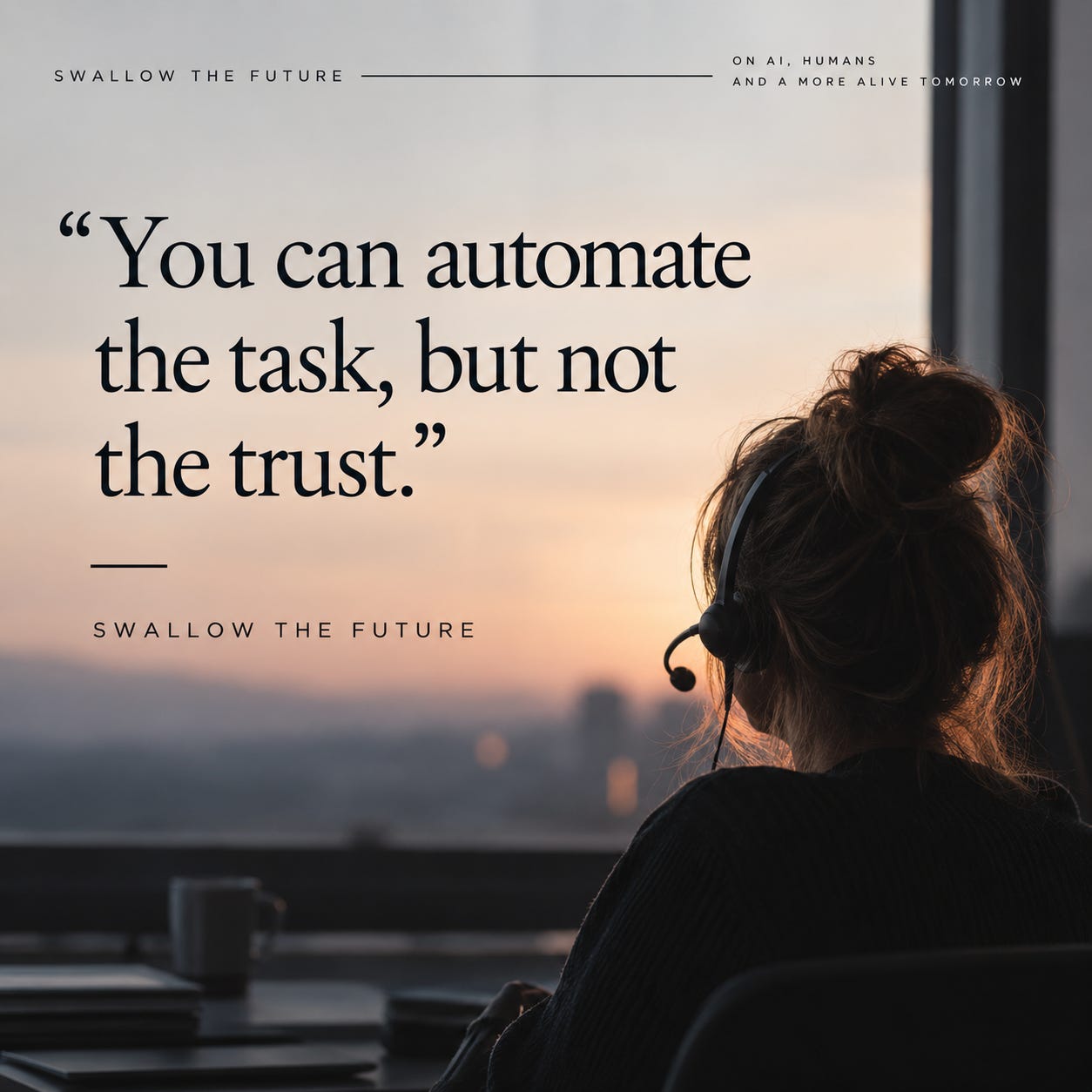
A person who has spent twenty-five years speaking to customers is also carrying memory. They know what people mean when they cannot quite explain it. They recognise the slight change in tone that signals confusion, fear or frustration. They know when the stated problem is not really the problem. They know when to follow the process and when the situation requires something more.
None of this makes automation impossible. But it makes the system more complicated than the task.
And I wonder whether that is one of the great organisational risks of the AI transition.
We are becoming extraordinarily good at seeing what can be automated before we have become equally good at seeing everything the human was actually doing.
The spreadsheet sees labour hours. The customer experiences reassurance. The workflow sees an interaction. The person on the other end experiences trust. The organisation sees a role. The team may experience continuity, memory, judgement and the person who quietly knows how things really work.
Much of that value is invisible precisely because, when it is working well, nothing dramatic happens. The customer does not escalate. The colleague does not make the mistake. The problem is noticed early. The difficult person calms down. The new employee learns how things are actually done. The relationship survives a bad experience.
Invisible value is still value.
But it is particularly vulnerable in a period of rapid technological change because our systems for measuring work have always been better at counting output than recognising relationship.
AI makes this tension sharper. The technology is astonishing at breaking work into components. It invites us to ask which parts can be generated, predicted, routed, processed or completed without a person.
That is a useful question. It is just not the only question.
We also need to ask what the task is connected to. What happens before it? What happens after it? What judgement surrounds it? What trust depends on it? What knowledge has accumulated around it? What changes elsewhere when it disappears?
Because an organisation is not a collection of isolated tasks. It is a web of relationships, decisions, habits, stories, incentives, informal knowledge and dependencies.
Pull one thread and sometimes nothing happens. Pull another and the whole thing shifts.
This is not an argument for preserving every job exactly as it exists today. That would be neither realistic nor desirable.
There is work we should automate. There are repetitive tasks that consume human attention without developing people or serving customers particularly well. There are systems that can make organisations faster, safer and more useful.
The opportunity is enormous.
But perhaps the quality of the transition will depend on whether we can distinguish between removing work and removing capacity.
They are not the same thing.
If a machine takes over routine administration and gives a person more time to solve complex problems, that may increase human capacity. If it removes the person who held the relationship, context and judgement that made the broader system work, the saving may be much less obvious.
That is what makes Kathryn’s story useful.
Not as proof that AI cannot replace customer-service work. It can already perform significant parts of it, and those capabilities will continue improving.
The lesson is that optimisation at the level of the task can create dysfunction at the level of the system.
And the faster the technology moves, the easier it becomes to miss that distinction.
There is another part of Kathryn’s story that stays with me.
She had helped train the technology.
She was not standing outside the transformation resisting it. She could see what the technology might make possible and how it could help people do their jobs better.
That feels important because the future of work conversation is too often framed as a choice between embracing technology and defending humans.
But most people do not want that choice.
They want the technology. They also want dignity.
They want automation to remove the parts of work that make them less human without quietly deciding that their humanity was dispensable too.
Maybe that is the more useful question for organisations now.
Not simply, What can this technology do instead of a person?
But, What becomes possible for the person when the technology does it?
That shift sounds small. It is not.
One question begins with substitution. The other begins with expansion.
And perhaps that is where the more interesting future lives.
Not in preserving every task because a human once performed it, and not in eliminating humans wherever software can achieve the same output, but in becoming much more precise about what we want technology to remove, what we want humans to retain, and what new forms of human capability might emerge when the two are designed together.
Because the real work of AI transformation may not be automation at all. It may be learning to see the work beneath the work.
The trust. The context. The judgement. The memory. The relationships.
The things that do not appear neatly in a productivity calculation but determine whether the system actually works.
Perhaps the organisations that navigate this transition best will not be the ones that automate fastest.
They will be the ones that understand what they are automating before they remove the human who understood why it mattered.
With love and curiosity,
Becs x