
It is 4:33 in the morning and I am sitting on a hospital floor, with my back against the wall and my eyes fixed on the monitors above the bed of someone I love. Numbers pulse and change, offering small moments of reassurance.
They are okay. This visit is for tests. But a few weeks ago, I thought I might lose them.
I am not going to describe those hours. Some things do not belong on the internet. What I will say is that there are moments that divide your understanding of life into before and after.
You discover how thin the distance is between the life you assume will continue and the life that could change with a phone call, a sentence, a scan or a sound from another room.
Most of the time we do not look at that fact directly because we could not function if we did. We answer emails, pack lunches, sit through meetings, worry about money, make plans for next year and think about the person we might become five years from now. We live, necessarily, as though there will be time.
And then something happens. For a moment, the veil lifts, and you understand not intellectually, but physically, that everyone you love is temporary, that you are temporary, and that all of this is temporary.
Once you have felt that knowledge in your body, it becomes surprisingly difficult to return to certain ways of thinking about the future.
Which is why, sitting here in the half-light of a hospital room, I find myself thinking about artificial intelligence. Not because technology feels particularly important at this moment, but almost the opposite. This is one of those places where the difference between intelligence and being alive becomes impossible to ignore.
AI can know that humans die. It can explain mortality. It can read philosophy, medicine, poetry and neuroscience. It can describe grief and recognise patterns in the language we use when somebody we love disappears.
But knowing that death exists is different from living inside the knowledge that this person could be gone.
That distinction matters because mortality is not simply a fact about human existence. It quietly shapes almost everything we value.
We love differently because things can be lost. We choose because we cannot pursue every possible life. We commit because time closes doors. We grieve because attachment has consequences. We forgive because sometimes there will not be another conversation. We say “I love you” because one day there will be a last time we get to say it.
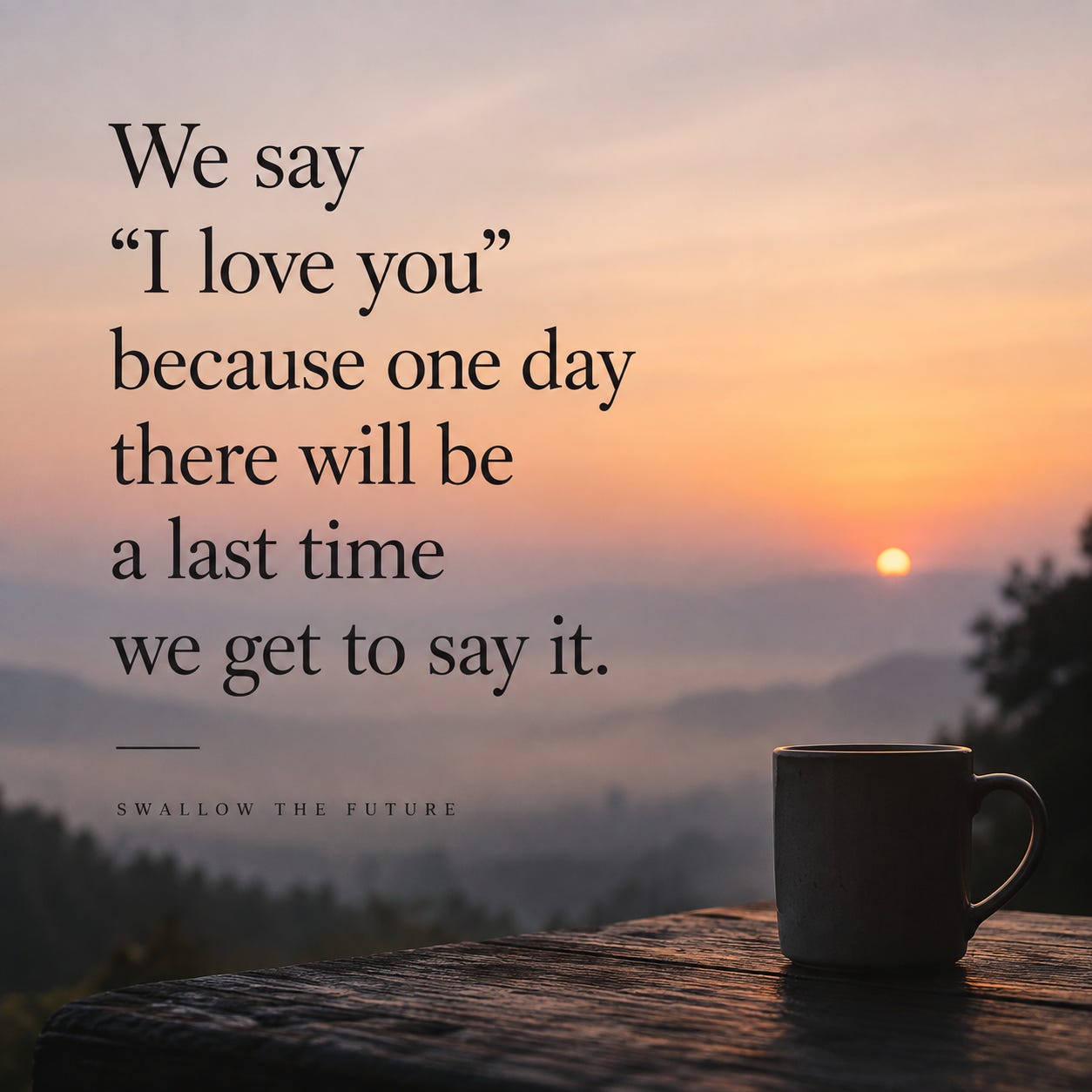
Finitude gives life its edges, and perhaps those edges are part of what give it meaning.
This is something I think we risk missing in our conversations about AI. We talk endlessly about capability. Which system is smarter? Which model can reason better? Which jobs can be automated? Which skills will retain economic value? What exactly will humans still be better at?
These are reasonable questions, but sometimes I wonder whether we are searching for human value in the wrong place.
Perhaps what matters about us is not simply the collection of tasks machines cannot yet perform. Perhaps it lies partly in the fact that our intelligence exists inside a mortal life.
Our decisions have consequences because we have something to lose.
Consider the moments that actually shape a life: leaving, staying, having the child, ending the relationship, starting the company, telling the truth, saying yes when there is no guarantee it will work, and saying no when it would be easier to remain agreeable.
There is often plenty of information available in those moments. What makes them difficult is not a lack of intelligence. It is consequence.
A machine may help us see the options. It may model possible outcomes. It may notice something we missed. But we are the ones who have to wake up inside the life that follows.
That changes the nature of judgement. It also changes the nature of care.
We have spent decades trying to make professional life cleaner, more rational and less emotionally entangled. Keep some distance. Be objective. Do not take things personally. There is wisdom in some of that, but I increasingly wonder whether attachment has been unfairly treated as a weakness.
The things we care about alter our attention. A child, a friendship, an idea, a piece of work, a community, a coastline, a future we may never personally see. When something matters to us, we notice differently. We stay longer. We listen harder. We take responsibility.
Care is not always efficient, but perhaps efficiency was never its purpose.
And this matters as AI becomes woven more deeply into the decisions we make. The more powerful our tools become, the easier it may be to confuse a technically optimal answer with a humanly meaningful one.
Those are not always the same thing.
A system can optimise for an outcome, but it cannot decide why the outcome should matter to us in the first place. That question comes from somewhere else: from history, culture, relationship, responsibility, the body, having loved and lost, and the knowledge somewhere beneath all our daily activity that we do not have forever.
Maybe that is also why lived experience matters so much.
Not because suffering makes us wise. It often does not. Not because trauma is something we should mine for productivity or turn into a personal brand. Some experiences should simply be survived.
But life leaves knowledge in us that cannot be acquired through information alone.
You can read everything ever written about grief and still not know what it feels like when the phone rings. You can study courage without knowing what your body will do when courage is actually required. You can analyse love without ever understanding the peculiar terror of having something you would be devastated to lose.
Our lives teach us from the inside.
And perhaps that form of knowing becomes more, not less, significant as access to external intelligence becomes abundant.
The machine can increasingly give us the answer, but it cannot tell us what the answer means inside this particular life. It cannot decide what we are willing to sacrifice, whom we are responsible for, what we refuse to betray, what deserves our limited attention, or what kind of ancestor we want to become.
Those are questions that only become meaningful because our time is finite.
I think this is where the conversation about humanity and AI becomes much richer than a contest over who is more intelligent.
Perhaps we are not competing at all.
Perhaps artificial intelligence is forcing us to confront how narrow our definition of intelligence became. We treated cognition as though it existed separately from embodiment, knowledge separately from consequence, decision separately from responsibility, and reason separately from love.
But human intelligence was never floating freely in the abstract. It has always belonged to creatures who can be hurt, who attach, who age, who fear, who hope, and who know, whether we acknowledge it or not, that there will eventually be a last morning.
It is nearly five now. The monitors are steady. Someone I love is sleeping beside me.
Soon the hospital will begin waking up. Trolleys will move through the corridors. Coffee will appear. Phones will start ringing. Life will resume its ordinary scale.
And I am grateful for that ordinariness in a way I was not before.
Perhaps that is the strange gift of seeing the veil. You return to the same life, but it is no longer quite the same life. The emails are still there. The ambition is still there. The work still matters. The future still asks things of us.
But something has moved underneath it all.
You understand that the point was never to hold onto everything, because you cannot.
The point is to decide what you are willing to love while you are here.
And as our machines become more powerful, perhaps that becomes one of the most important human questions of all: not simply what can we do now, but what is worth doing with the time we have?
With love and curiosity,
Becs x